
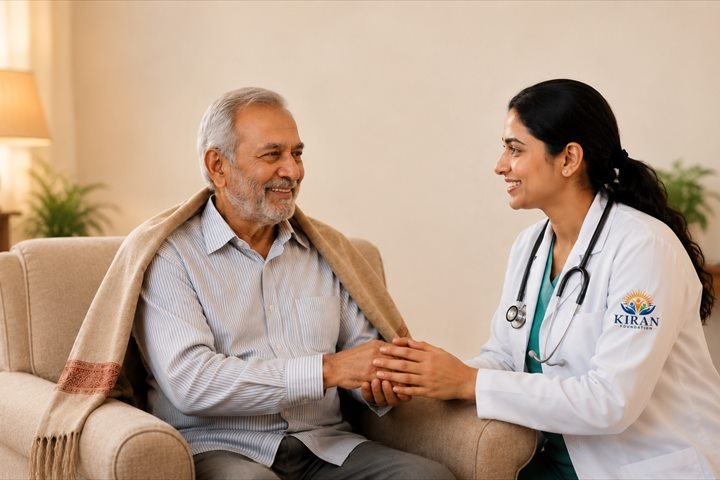
What happens when a doctor finally arrives in a village that has never had one? Notes from three days at our mobile health camp.
The queue starts before the table is set up. This surprises people the first time they volunteer at a camp, and it stops surprising them by the second morning. Word travels the previous evening, and by seven the line has formed, mostly older people, mostly women, several of whom have walked in from further out.
What is striking is not how sick everyone is. Most people in the queue are broadly fine. What is striking is how long some of them have been carrying something small that has quietly become something large, because there was never a convenient moment to have it looked at, and never a doctor within reach on the day they could spare.
Day one: the backlog
The first day of a camp is not really medicine. It is a backlog being cleared. Blood pressure that nobody has measured in a decade. A cough that has lasted since winter. A cut on a foot, in a person with diabetes, that should have been dressed six weeks ago and is now the most serious thing we will see all day.
We referred four people to hospital on the first day. Three of those four had no idea anything was wrong. That ratio is normal, and it is the entire argument for holding camps at all.
The expensive illnesses are almost never the ones that arrive suddenly. They are the ones that were available to be found, cheaply, years earlier.
Day two: the conversations
By the second day the queue is shorter and the conversations are longer. People come back with a relative. Somebody brings her mother, who would not come yesterday. A man who took his prescription on the first day returns to ask what the tablets are actually for, which nobody had ever explained to him.
A good part of the second day is spent on that: explaining what a diagnosis means, what the medicine does, and why it has to continue after the symptoms stop. In a household where money is tight, a course of tablets is usually abandoned the moment the person feels better, because continuing feels like waste. That is not ignorance. It is a reasonable decision made with incomplete information, and it can be fixed with ten minutes of somebody's time.
Day three: the part that costs money
The third day is the referrals. This is where a camp either means something or does not. It is straightforward to tell somebody they need to see a cardiologist. It is a different thing entirely to make sure they get there, that the test is paid for, and that whatever is prescribed afterwards actually gets bought every month.
This is where our father's experience shapes what we do. He was a veterinary doctor, and he lived with heart disease himself for years. In both halves of that the difficulty was never the diagnosis. It was the endless follow-on cost that came after it. So we do not treat a referral as the end of our involvement. We pay the hospital or the chemist directly, and we keep going back.
- ₹350 covers one person seen and treated at a camp.
- ₹12,000 covers a full day's camp in one village.
- ₹3,000 covers a month of medicines and tests for one patient.
Three days, one village, a folding table and two doctors. It is not a hospital. But for the four people we sent onward, it was the difference between a condition that gets treated and one that gets discovered too late.
Share this story: Volunteer at a camp